
Publication 26 February 2026
Generative AI in 2025: Current Status and Outlook

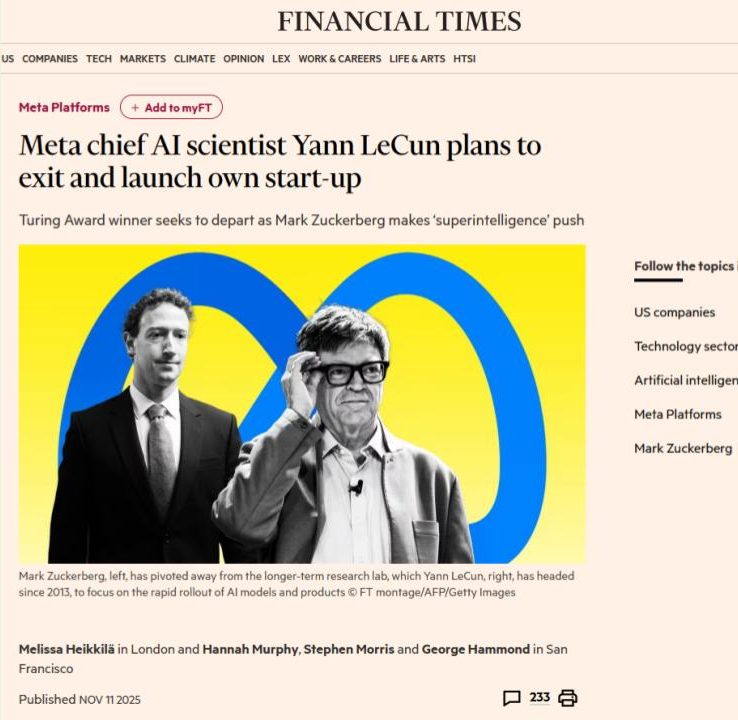
Description : Meta chief AI scientist Yann LeCun plans to exit and launch own start-up, Financial Times, November 11, 2025, https://www.ft.com/content/c586eb77-a16e-4363-ab0b-e877898b70de
November 2025 was marked in particular by the announcement of Yann Le Cun’s departure from Meta. We were told at the time that this was so he could focus on “World Models” rather than LLMs—an approach that Meta is now pursuing. LLMs, World Models, Frontier Models—what are we talking about?
Clément Bénesse :
An LLM stands for “Large Language Model.” These are the models we use every day, and ChatGPT is the best-known example. One of the major breakthroughs was realizing that one way to construct a sentence is simply to string words together. The model operates on this incremental iteration, thanks to the Transformer architecture, which allows words to be generated sequentially. Since GPT-3, this architecture has been pushed to its limits, with various improvements. But fundamentally, we’re still working within the same paradigm. Yann LeCun, however, doesn’t buy into it: he believes that this architecture will not lead to Artificial General Intelligence (AGI); (Editor’s note: see our latest report “Promoting AI Literacy for an Inclusive and Emancipatory Society,” particularly page 61).
This is where the World Model framework comes into play. ChatGPT excels at memorization and “in the style of” writing, but it struggles to generalize. It has memorized a large portion of the internet and can retrieve information when prompted. Yann LeCun wants to “step out of Plato’s cave”: to base AI not on an understanding of the internet (via words), but on an understanding of the real world, particularly through video analysis.
We’ve seen this lack of understanding through simple tests. Try asking an AI to generate an image of a watch that doesn’t show 10:10! It’s tricky, because AIs are trained almost exclusively on advertising photos where the watches show that time.
Laurent Daudet :
In fact, for an LLM, a bottle is just a word. It doesn’t understand its tangible, physical meaning. World Models seek to bridge this gap. This may include analyzing real-world videos to advance robotics, for example.
As for Frontier Models, they represent the cutting edge of LLM research. These are the highest-performing models and represent attempts to explore architectures other than traditional LLMs.
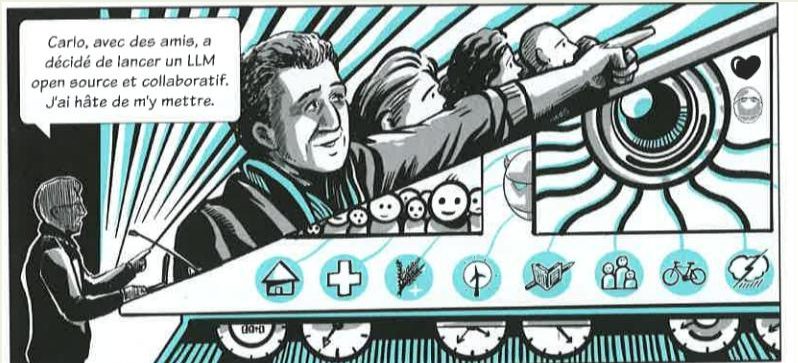
Description : Excerpt from “Dream Machine, or How I Almost Sold My Soul to Artificial Intelligence”, screenplay: Laurent Daudet, Appupen, dessin : Appupen, éditeur : Flammarion, 2023. © Flammarion.
Today, we’re faced with a proliferation of AI models—from Hugging Face, with over 2 million models, to China, which produces several thousand each month. One might wonder if there’s a disconnect between technological progress and the reality of AI deployment in businesses. Can you tell us more about this deployment?
Laurent Daudet :
The deployment of AI relies first and foremost on a philosophy that must be fully understood. We do not need massive models with 500 billion parameters to meet the majority of business needs. There is a “sweet spot”—around 40 to 50 billion parameters—that covers most targeted use cases. These models can be obtained through distillation. In other words, we train a smaller model to replicate the performance of a larger one, which allows us to transfer its capabilities at a lower energy and operational cost.
But technology alone is not enough. At LightOn, we’ve found that companies need guidance above all else. In sectors such as banking, healthcare, and insurance, privacy requirements are very strict. We therefore need to analyze employees’ workflows to identify what can actually be optimized or automated, rather than simply adding yet another tool. That’s why our business focuses primarily on consulting, in addition to technical services.
Clément Bénesse :
Very large models pose a real scalability problem. They cannot run locally without extremely powerful infrastructure, which requires sending data to external servers. This raises major privacy, security, and ethical concerns. Conversely, models that are too small lack the capacity to handle certain complex tasks. This brings us back to the trade-off Laurent mentioned—that “sweet spot” where performance and operational deployment can be balanced. Furthermore, the AI ecosystem relies heavily on an “open model” culture, with models whose weights are public and downloadable—unlike closed solutions such as ChatGPT, Claude, or Gemini. Sharing these models is inexpensive and essential to the sector’s vitality. They can then be adapted to the specific needs of businesses through fine-tuning or quantization.
Jordan Ricker :
Beyond technical considerations, there is the question of AI’s acceptability within organizations. This acceptability varies greatly depending on the sector and the target audience. In the insurance industry, for example, accidental human error is often more readily tolerated than random errors made by artificial intelligence. This creates a significant gap in how these tools are perceived.
Identifying relevant use cases therefore also involves taking into account the social reception of AI, end-users’ expectations, and their level of trust. Without this preliminary work, even technically advanced solutions may fail to deliver the expected benefits.
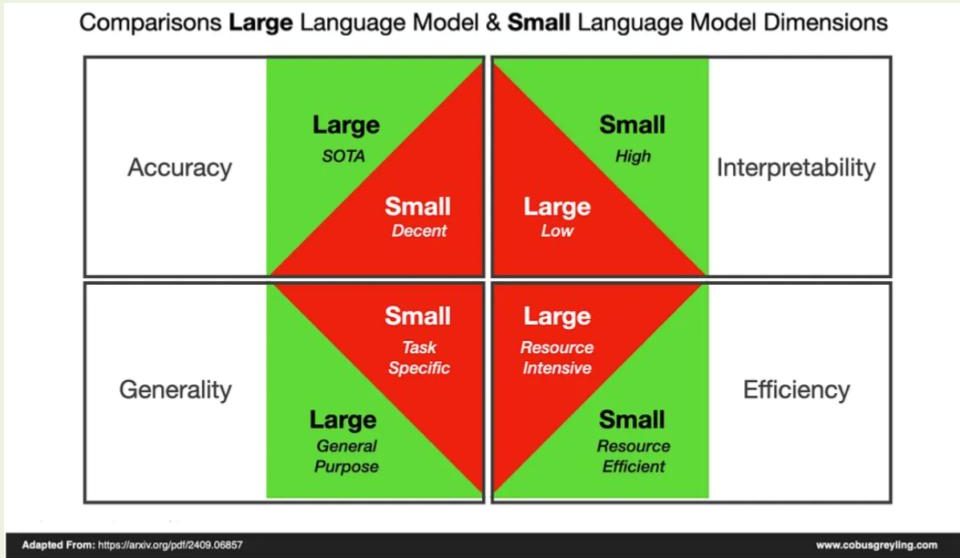
Description : Lihu Chen, Gaël Varoquaux, “What is the Role of Small Models in the LLM Era: A Survey”, https://arxiv.org/pdf/2409.06857
On December 2, Mistral announced the Ministral models. What is the strategy behind offering variations of the larger models?
Clément Bénesse :
The idea is to match the right model with the right person and the right task. A company like Mistral needs to reduce its inference costs, particularly the costs associated with the model’s “reasoning” phase, which are especially high with new models that generate chains of reasoning. This technique enables models to produce significantly more relevant content. Being able to deploy a model of the right size in the right place is a real economic advantage.
From my perspective, OpenAI took a series of blows in 2025. First, Chinese open-source models reached an excellent level of performance. Second, Google has a colossal amount of data and an interface that everyone is already familiar with, which reduces the friction of adoption. Before, OpenAI could afford to take more risks, such as the idea of introducing advertising. Today, the competition is much fiercer.
Jordan Ricker :
There’s a lot of hype surrounding venture capital and the U.S. stock market. In reality, we don’t need such complex models for simple tasks like formatting or summarizing short texts. For certain critical applications—such as a robot that interacts with children—you can choose to deploy a very powerful model that accounts for all risk scenarios, or simply code strict restrictions without resorting to machine learning. We don’t need AI everywhere. But that doesn’t necessarily appeal to investors.
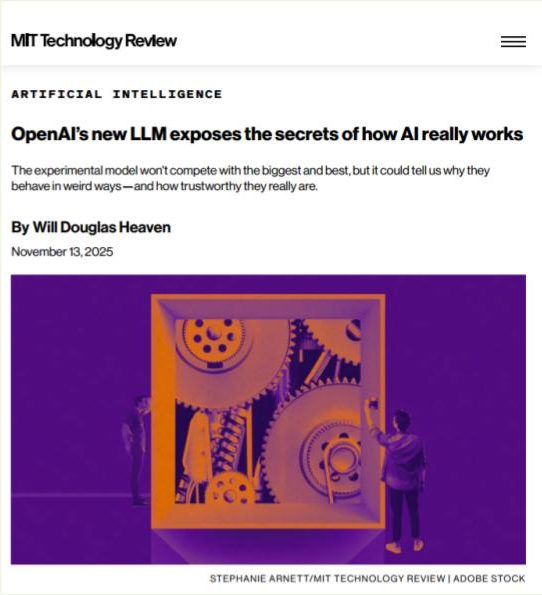
Description : OpenAI’s new LLM exposes the secrets of how AI really works, MIT Technology Review,November 13, 2025, https://www.technologyreview.com/2025/11/13/1127914/openais-new-llm-exposes-the-secrets-of-how-ai-really-works/ (article payant)
On November 13, 2025, OpenAI unveiled a “sparse network” model that would provide greater insight into the inner workings of AI. What is the current state of our understanding?
Clément Bénesse :
The OpenAI paper is undoubtedly a public relations move. We’ve been trying to understand how AI works internally since 2018–2019. We shouldn’t confuse explainability (which neuron fires for which concept) with interpretability (why the model gives this specific answer). From my perspective, the real goal is to reassure users and help them better understand what’s going on.
Laurent Daudet :
Science in AI is lagging behind engineering. We’re able to build extremely powerful models, but basic research is struggling to keep up. We don’t necessarily know how to explain all emergent behaviors, particularly “agent-like” behaviors. Researchers are beginning to understand how this works in simplified models. I’m thinking in particular of Lenka Zdeborová at EPFL, who is studying how capabilities increase with model size. They would first learn the meaning of words, then the context. But we’re still working with “toy models.”
Jordan Ricker :
Large foundational models, such as those developed by OpenAI, remain black boxes, with the primary source of opacity being the training data—long before their conversational capabilities come into play. We should commend the various European initiatives that are creating models using open, transparent data.
Description : Disrupting the first reported AI-orchestrated cyber espionage campaign, Anthropic, November 2025, https://www.anthropic.com/news/disrupting-AI-espionage
On November 23, 2025, Anthropic published a report on Chinese hackers who allegedly asked Claude for a plan to defend against a cyberattack, only to use that same plan in an actual attack. What is the current state of AI in cybercrime?
Laurent Daudet :
This is not trivial information. It shows that small teams are now capable of operating on a scale that was previously unthinkable. AI makes it possible to identify weaknesses in systems and to launch a vast number of tasks planned by agent-based AI systems.
Jordan Ricker :
We are seeing an explosion in automation capabilities, but also a decline in barriers to entry for malicious activities. We are also witnessing a form of “cybercrime craftsmanship,” with isolated individuals unwittingly spreading manipulative messages amid the sensationalist content they share on a large scale across platforms to profit from it…
Laurent Daudet :
We were talking about “vibe coding”—that is, coding solely with the help of AI without really knowing the code. We’re almost at the point of “vibe hacking.”
Do you think LLMs will slow down to the point of hitting a “wall,” or do you think they will, on the contrary, continue to make progress?
Laurent Daudet :
People talk about a wall the way they used to talk about “peak oil,” but we don’t see it yet. The laws of scaling continue to hold true with ever-larger models and training runs. This phenomenon has even intensified, since we’re now scaling both pre-training and post-training. Pre-training focuses on raw data, while post-training focuses on specific tasks. We’re also scaling inference (the time it takes for the model to process a request before responding to the user), with dozens or even hundreds of calls to the LLM for agent-based AIs. Scaling still has a bright future ahead of it.
Clément Bénesse :
There is the issue of computing power, since we’re dealing with very large-scale architectures—similar to those used in data centers—that come with significant energy and economic constraints. However, several factors are driving continued progress, such as higher-quality post-training data. This is the data that is fed into the model at the very end of training and has a major impact on the final quality, as demonstrated by the work of DeepSeek.
The “Mixture of Experts” architecture also makes it possible to obtain more accurate answers on certain topics at a lower total cost. I’m fairly optimistic, because we’re realizing that we can use AI as part of a broad arsenal of combined tools.
-

Publication 13 October 2025
Developing AI literacy for an inclusive and empowering society
-
Event

What governance for a responsible artificial intelligence?
Thursday, 13 November, from 9 am to 8 pm
Campus Fonderie de l'Image / L'Ecole Multimédia, 83 avenue Gallieni, 93170 Bagnolet