
Publication 22 November 2024
What role for the citizen in the governance of artificial intelligence?


Introduction
At a time when artificial intelligence (AI) technologies are becoming mainstream in many areas of society, major questions are being raised about their impact on citizens, particularly given the ethical issues they raise. In order to limit potential risks and maximize the opportunities associated with AI, numerous initiatives aimed at organizing its governance are multiplying. Examples include the Partnership on AI, the European regulation on artificial intelligence (AI Act), and the report “Governing AI for Humanity” recently published by the United Nations, to name but a few.
It is important to note here that the term “governance” does not refer solely to efforts to regulate AI. Rather, it refers to all the processes, rules, standards, and policies that aim to support the deployment of these technologies and their uses. A large number of actors contribute to the development of AI governance: non-governmental organizations (the Mozilla Foundation, the AI Now Institute), intergovernmental organizations (the United Nations, the OECD), standardization agencies (the International Organization for Standardization (ISO), CEN-CENELEC), professional associations (the Partnership on AI, the Frontier Model Forum), industry, academia, and, of course, parliaments.
For the time being, citizens seem to be largely uninvolved in these governance efforts. However, in order to ensure that decisions taken in the “upper echelons” of the public and private sectors reflect the needs and concerns of society (particularly with regard to ethical and environmental considerations), their participation appears essential. How, then, can we reinforce the role of citizens in AI governance? Are there any initiatives in this regard and, if so, what forms of participation do they offer? What are their limitations and how can we overcome them?
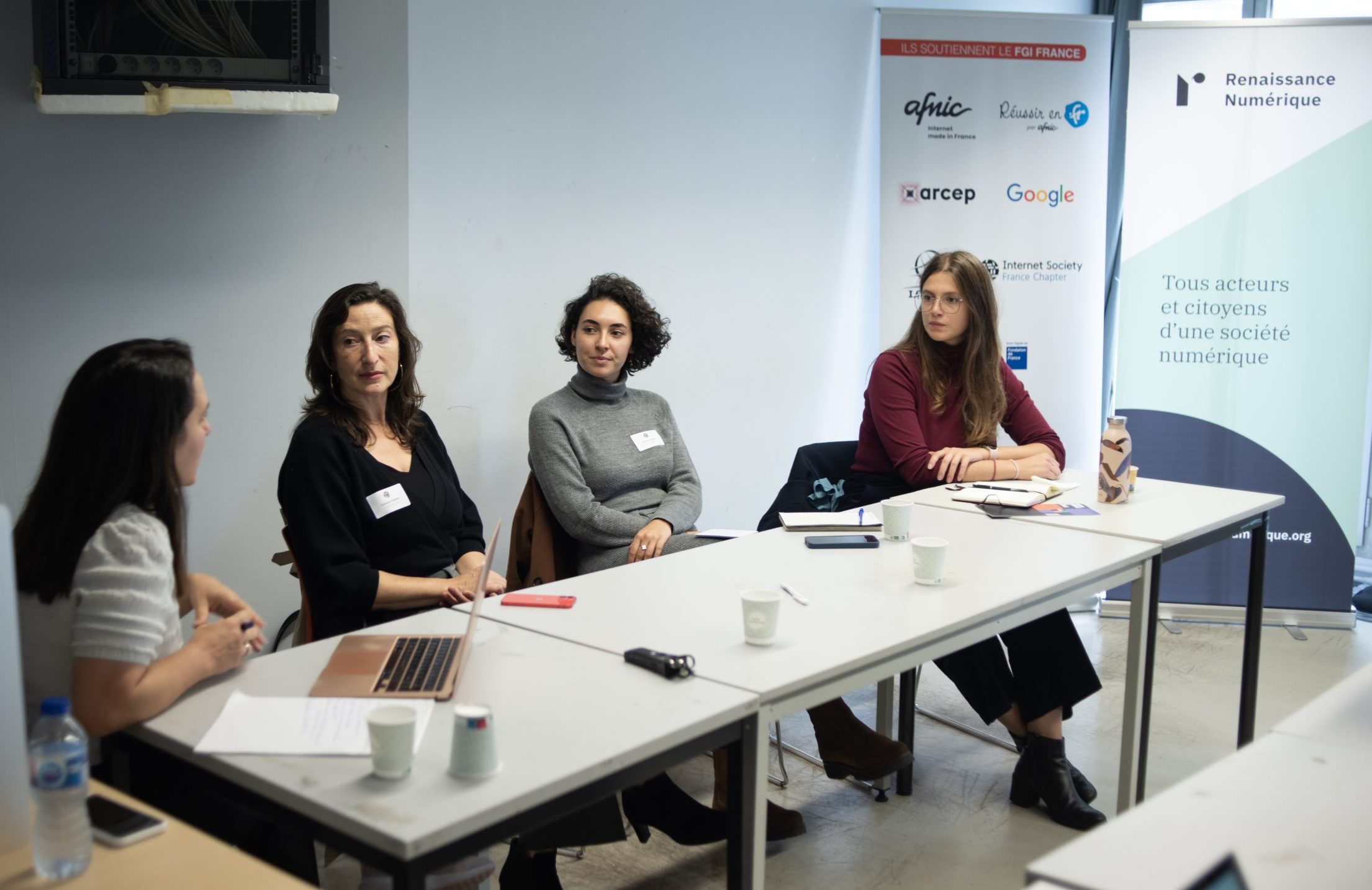
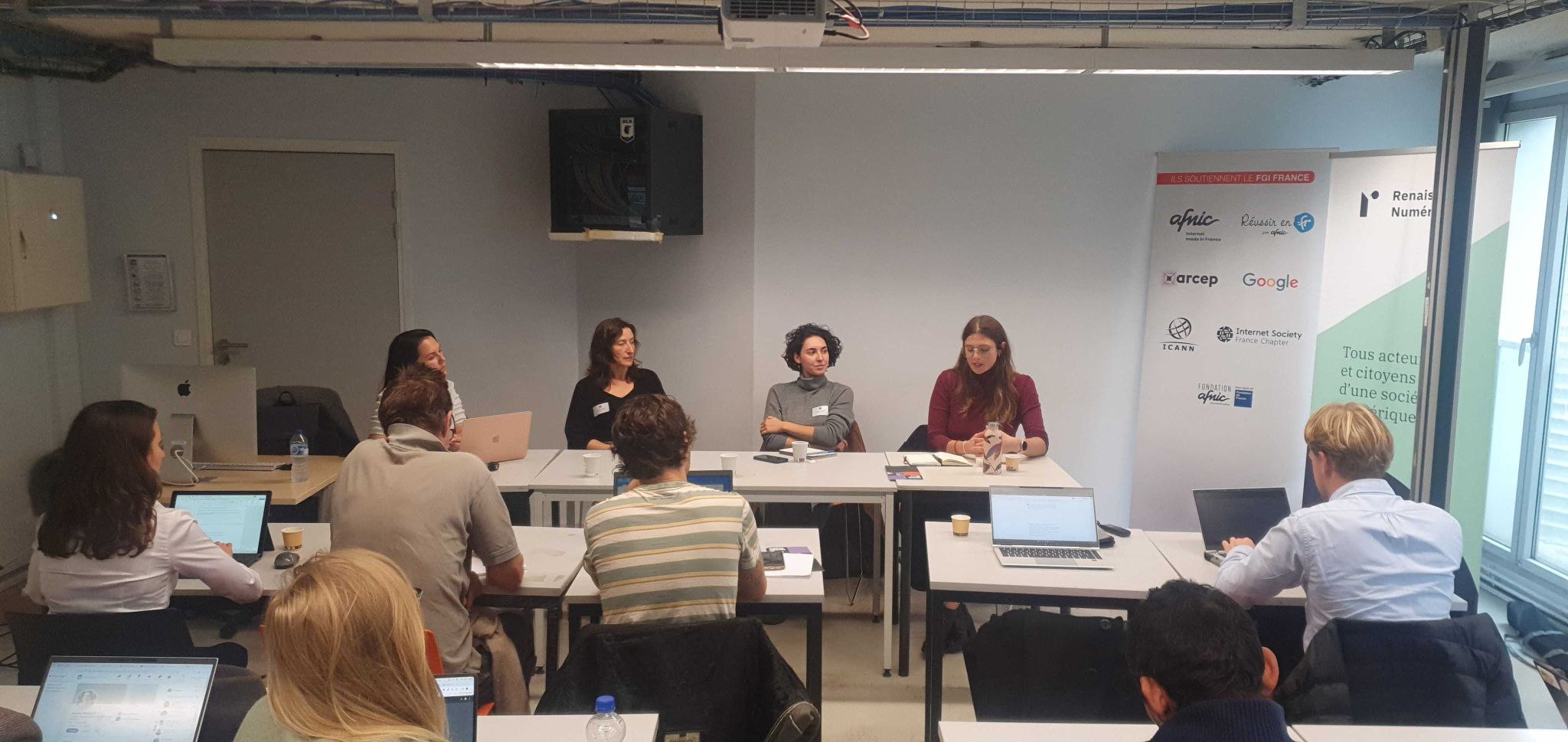
To answer these questions, Renaissance Numérique organized a round table discussion titled “What role should citizens play in the governance of artificial intelligence?” on October 3, 2024, as part of the France Internet Governance Forum (IGF). Following the AI Dialogues organized by the think tank, this event is part of a broader reflection led by Renaissance Numérique on civil society participation in international AI governance. These discussions are also part of the preparations for the AI Action Summit, which will be held in Paris on February 10 and 11, 2025.
This round table brought together three speakers: Giulia Cibrario (Policy Analyst at the OECD, specialist in citizen participation and digital democracy), Céline Colucci (General Delegate of Les Interconnectés), and Jeanne Perreul (Participatory Projects Manager at Missions Publiques). All three shared their perspectives and concrete feedback, particularly on the obstacles to be overcome in order to ensure that citizen participation in AI governance is not merely a “facade” This summary recounts their discussions.
Jeanne Perreul
Missions Publiques
Hearing citizens’ voices on AI: examples of initiatives at the local, national, and international levels
Firstly, this round table discussion highlights that citizen participation in decisions relating to complex technologies, such as artificial intelligence, is essential in order to include non-technical perspectives from non-experts. For Jeanne Perreul (Missions Publiques), it is fundamental to create spaces where citizens can share their opinions on technologies that have a major impact on their daily lives, particularly on ethical, social, and environmental aspects. As the expert points out, “AI is not too complex or too technical a subject for citizens, contrary to what one might think—experience has shown that they have things to say”. One of the key points, she explains, is to ensure that a variety of expertise is brought to the participatory processes so that citizens can better understand and engage with the subject. This helps to demystify the subject and ensures that participants have something to say. “We are not looking for an opinion but an informed view in the processes we support, in order to better guide the thinking of public decision-makers”, she adds. Giulia Cibrario (OECD) agrees with her on this point and cites the example of inclusive mechanisms developed in several OECD countries, such as Austria, Korea, and Canada. Beyond these few examples, initiatives are emerging at different levels, ranging from local consultations to world-wide dialogues.
In France, citizen consultations are multiplying at the local level, particularly in line with the call launched by Les Interconnectés, France Urbaine, and Les Intercommunalités de France to organize local consultations on artificial intelligence throughout France. Their goal is to “make AI a subject of public debate before any widespread deployment”. Taking a bottom-up approach, the aim of these consultations is to bring the questions raised by citizens and local stakeholders to the attention of political decision-makers. In addition, the 30 local authorities already involved, such as Rennes, Nantes and Montpellier, are pooling the results of their consultations in order to draw up proposals or political positions that reflect the expectations of the stakeholders surveyed, explains Céline Colucci (Les Interconnectés). These regional consultations are open to any local authority wishing to engage in debate with regional stakeholders (public, private, citizens, etc.) and collectively share the lessons learned. A methodology kit has been developed to harmonize these approaches, including a code of conduct guaranteeing transparency and commitment throughout the process. In March 2024, The Citizens’ Convention on Artificial Intelligence held in Montpellier has issued its opinion, which identifies eight imperatives: “AI must be useful,” “the environmental impact of AI must be controlled,” “guarantee privacy protection,” establish “neutral and independent controls,” “ensure transparency” in the use of algorithms and data, “guarantee control over autonomous AI,” consider AI “as a tool and support for public services,” and “make AI accessible to as many people as possible.” For Giulia Cibrario (OECD), these local consultations are extremely important and can have a very wide reach, even influencing decisions taken at the supranational level.
As part of Belgium’s Presidency of the Council of the European Union in the first half of 2024, the Belgian government, in collaboration with Missions Publiques, invited 60 citizens to participate in a panel to discuss what artificial intelligence means to them and what they expect from the European Union on this issue during its next term. The aim of this panel was to “gather a non-technical, citizen-based perspective on the challenges of AI, to guide Belgium and the EU on AI issues. In this context, citizens addressed a variety of topics such as the economy, the environment, security, and human relations”, explains Jeanne Perreul (Missions Publiques). The discussions resulted in nine key messages that highlighted citizens’ priorities for the ethical and beneficial development of AI, in particular by ensuring that AI remains a tool at the service of humans and by limiting its environmental and social impact as much as possible. The results of this process have been forwarded to the European institutions with a view to contributing to the European Union’s strategy on AI.
In partnership with the Stanford Deliberative Democracy Lab, Missions Publiques plans to organize a decentralized global dialogue on artificial intelligence in 2025. Inspired by an initial global dialogue on the future of the internet designed in 2020, this project aims to bring together a multi-stakeholder coalition to create spaces for exchange where citizens from around the world and from all walks of life can discuss various issues related to AI governance. The goal is to incorporate the perspectives and concerns of citizens, particularly the most marginalized populations, in order to ensure the inclusive, equitable, and sustainable use and development of AI. Through local events organized in more than 100 countries and a global deliberative poll, the process will engage AI governance stakeholders (governments, the private sector, international organizations, academia, and civil society) to promote the impact of the ideas gathered from citizens. The ideas gathered will be shared with key AI governance stakeholders, including governments, industry, and international organizations. This initiative, scheduled to launch in February 2025 at the Summit for Action on Artificial Intelligence, could set a historic precedent for citizen involvement in major global issues such as climate change.
Challenges to citizen participation and how to overcome them
While the few examples discussed during the roundtable helped to amplify citizens’ voices in societal choices regarding AI, the three speakers identified several obstacles to overcome. These obstacles, however, are not unique to artificial intelligence and concern citizen participation more generally. Among them, the lack of human and financial resources emerged as a major hurdle. Transcription and report writing, for example, were cited as extremely time-consuming tasks. Ideally, Giulia Cibrario (OECD) told us, “it would be necessary to systematize the availability of resources dedicated to citizen participation at both the local and national levels.”
She further emphasizes that ” current citizen participation initiatives are not truly representative . “ According to her, it is necessary to rethink the accessibility and inclusion processes of these initiatives. Echoing this point, an audience member remarks that populations from the so-called “Global South” are very rarely represented in this type of initiative. In this respect, the decentralized global dialogue project led by Missions Publiques seems to be an exception: “We want to hold dialogues in as many countries of the Global South as possible ,” explains Jeanne Perreul (Missions Publiques).
Furthermore, hearing citizens’ voices is one thing – truly listening to and taking them into account is quite another. As the three speakers emphasized, there is a significant risk of consultations being exploited. Governments, for example, may be tempted to organize participatory processes to demonstrate their goodwill, without actually using the results in any way. However, when citizens do not perceive any concrete feedback or real impact stemming from their participation, the lack of follow-up from the organizers can undermine trust in these mechanisms. ” There have been too many examples of citizen participation initiatives that are actually more about public relations and do not lead to a genuine consideration of citizens’ concerns. This is a significant problem, a factor in the inadequacy of policies implemented and in citizens’ distrust. That is why we have established in a joint charter the principle of a clear commitment to the follow-up given to the work, ” observes Céline Colucci (Les Interconnectés).
Therefore, one of the factors not to be overlooked during these processes is transparency towards citizens, who must be aware of the impact they can or cannot have. The adoption of charters guaranteeing this transparency, the firm commitment of the stakeholders involved, and the implementation of rigorous follow-up after consultations have emerged as key elements to ensure that citizens’ voices are truly taken into account. These approaches maximize the impact of citizen participation and assure citizens that their voice carries real weight in decisions, thus strengthening their trust in the processes.
Finally, it emerged from the discussion that, within the framework of global dialogues such as the one envisaged by Missions Publiques, the involvement of various stakeholders (governments, non-governmental organizations, companies, etc.) is essential to maximize the impact and ensure that the results of these dialogues permeate all spheres that contribute to shaping the uses and governance of AI.
Céline Colucci
Les Interconnectés
What if AI were part of the solution?
According to the speakers, artificial intelligence as a tool has the potential to make participatory processes more inclusive and more efficient, by facilitating accessibility and participation for all citizens, regardless of their profile.
Giulia Cibrario (OECD) draws our attention to the fact that AI can improve accessibility to these processes by offering automatic translation and language simplification tools, enabling people who speak different languages or have varying levels of comprehension to access and fully engage in discussions. She also mentions the use of virtual assistants that facilitate participants’ interaction with deliberative processes, making them more fluid and intuitive. Furthermore, she explains that AI can be used to visualize future scenarios, for example, by generating images that illustrate the potential impact of certain public policies, such as the reorganization of a public space. This approach makes discussions more concrete and accessible to citizens, thereby fostering their understanding and strengthening their engagement.
For organizers of deliberative processes, AI also offers the possibility of partially automating certain repetitive and time-consuming tasks, such as transcription and report writing. The administrative burden is indeed very heavy in these processes, and AI can help alleviate it. In the specific context of public consultations, entrusting certain tasks to AI frees up time and resources, allowing organizers to focus on what matters most: the content of citizen discussions. For example, tools like Panoramic , developed by Make.org, help analyze contributions, thus facilitating the synthesis of ideas submitted by a large number of participants.
Conclusion
While citizen participation in AI governance is crucial, it presents significant challenges. This roundtable highlighted the fact that, despite the existence of various initiatives aimed at amplifying citizens’ voices on AI-related societal issues, these processes encounter both institutional and technical obstacles. Jeanne Perreu (Missions Publiques) rightly pointed out that, while AI is not overly complex for citizens, it is essential to ask the right questions—questions that are accessible and ethically and socially relevant. This approach prevents citizen participation from being reduced to a superficial or purely technical consultation, where citizens lack the necessary skills to contribute meaningfully. The discussions also revealed that one of the keys lies in establishing a follow-up process after each participatory initiative. This follow-up, combined with genuine political will, strengthens citizens’ trust and maximizes the impact of their contributions. Finally, it appears essential to put in place a governance framework that values the empowerment of citizens through mechanisms of transparency and deliberative inclusion: citizens must see the tangible effects of their participation.
Following this event, Renaissance Numérique will soon present the final report of its AI Dialogues project , conducted between April and October 2024. This report will include action plans to better integrate civil society into global AI governance. In light of this work, there is no doubt that this topic will occupy a central place in the discussions taking place at the AI Action Summit in February 2025.