
Publication 10 March 2026
AI : moving beyond dystopias, recognising social reality

AI in an already highly digitised society
In his interview for the journal Approches coopératives (No. 25, Summer 2025), Jean-François Lucas begins by reminding us how digital technology has become a defining feature of French society. He highlights the infrastructure (fibre, 4G, equipment) and very high levels of equipment ownership, while emphasising that these figures mask persistent inequalities between regions and social groups.
Digital technology is therefore not an « addition » to society, but an environment that reconfigures access to rights, information, public services, and economic opportunities. In this environment, AI is part of a landscape already marked by digital divides, asymmetrical power relations and dependencies on large platforms.
From dystopian visions to real-world applications
The interview addresses the fact that the dominant narrative on AI is largely structured around dystopian or futuristic visions : threats to employment, fantasies of superintelligence, scenarios of loss of control, etc. This narrative feeds into the idea that AI is an autonomous, inevitable force that will impose itself on society without any real democratic control. The Renaissance Numérique delegate proposes shifting our perspective. Rather than focusing on hypothetical « general » AI, he invites us to look at the very concrete uses already at work in government, businesses, services, platforms and professions. AI is now a social reality, embedded in organisations, public policies and economic models, and it is here that the real issues of power, inequality and regulation are at stake.
Powerful technology that is neither neutral nor magical
The interview emphasises that AI systems remain statistical models, governed by specific objectives, data, technical architectures and design choices. They have no consciousness or intentions of their own, but they produce very real effects when tasked with sorting, recommending, rating or assisting in decision-making.
Therefore, the question is not whether or not to « believe » in AI, but rather who designs it, with what data, within what legal and political framework, and in the service of whose interests. It is from this perspective that Jean-François Lucas emphasises the need to debate its uses, rather than relying on a technicist discourse that naturalises technical choices.
Training in AI as part of a comprehensive approach to digital technology
The chief executive of our think tank also stresses the importance of not viewing « AI training » as an isolated segment, disconnected from other digital issues. The culture of AI must therefore address issues of access, skills, social inequalities and platform structuring at the same time.
It is in this context that he refers to Renaissance Numérique’s work on AI literacy as a democratic, social and economic lever, echoing the report « Deploying AI literacy for an inclusive and empowering society ». The challenge is not only to impart technical skills, but also to enable citizens to understand the uses, limitations, biases and systemic effects of these technologies.
Giving civil society its rightful place
Finally, during the interview, he reiterates the need to make digital technology (and AI) a subject of public debate, rather than a matter reserved solely for experts or industrialists. In this regard, he points out that our association defines itself as a space for dialogue, bringing together companies, researchers, NGOs and institutional players who do not necessarily share the same interests but are open to different points of view.
The interview implicitly concludes that AI will only be emancipatory if its direction, uses and regulation are debated and developed collectively, far removed from simplistic narratives that oscillate between fascination and impending disaster.
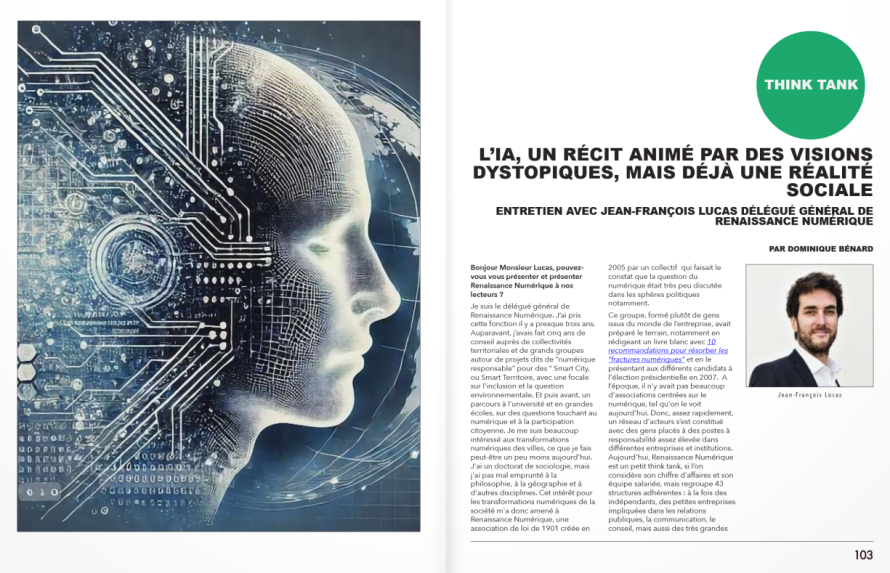
Read the full interview with Jean-François Lucas, « AI : a narrative driven by dystopian visions, but already a social reality », in issue no. 25 (Summer 2025) of the journal Approches coopératives, pages 103-107.
-

Publication 19 February 2026
AI literacy for NGOs
-

Publication 13 October 2025
Developing AI literacy for an inclusive and empowering society
-

Publication 17 April 2025
Towards a Global Cooperation Around AI Safety